Astronomy: The Science of Celestial Bodies
Astronomy, the fourth and culminating mathematical science of the Quadrivium, is the study of the celestial bodies and their motions. It encompasses both practical observation of the heavens and theoretical understanding of cosmic structure and principles. In classical and Masonic tradition, astronomy is understood as the highest science, revealing the most profound principles of divine wisdom expressed through the vast cosmos.
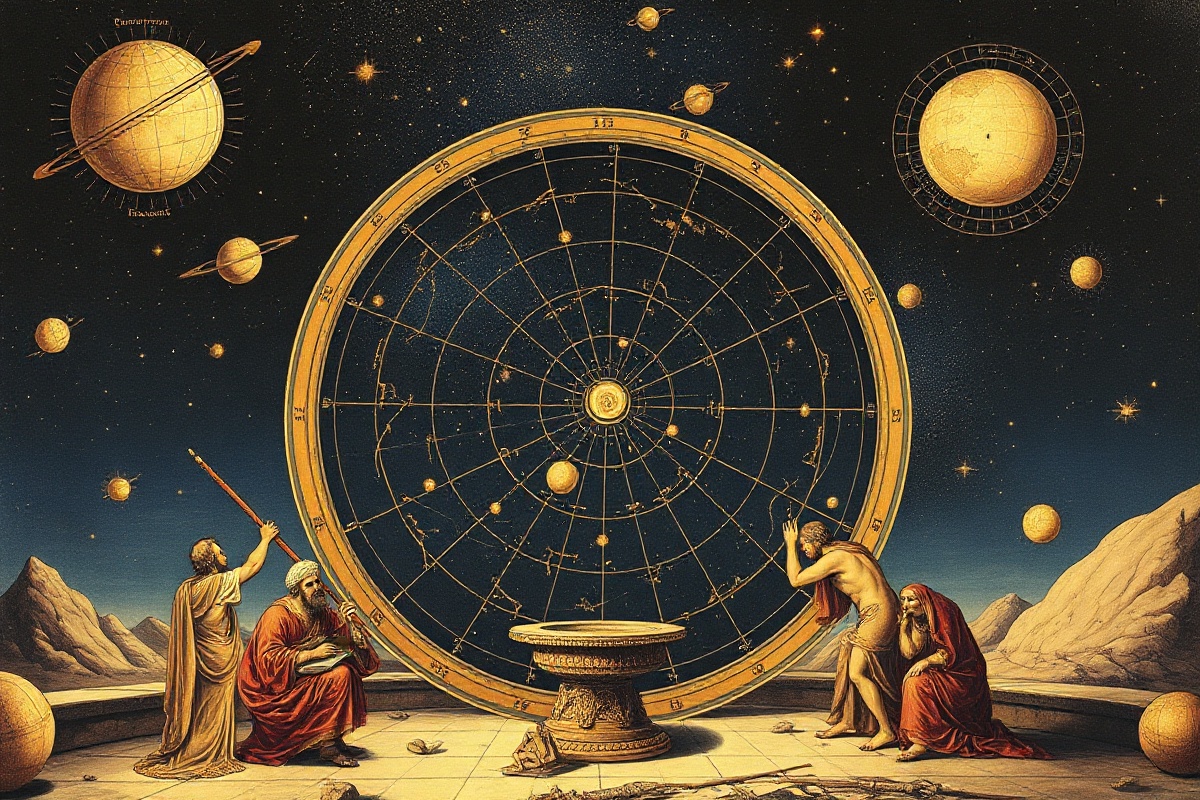
The Science of Celestial Motion
Astronomy is classically defined as the science of celestial bodies and their motions. Unlike astrology, which seeks to determine how celestial bodies influence human affairs, astronomy studies the cosmos for its own sake—to understand the structure and operation of the heavens. The word itself comes from Greek, meaning "star law" or "law of the stars."
In classical thought, the celestial realm was understood to be governed by eternal, unchanging laws. The motions of the heavenly bodies were predictable and knowable. The regularity of celestial mechanics—the fact that the stars maintained their positions relative to each other, that planets and moon followed predictable paths, that eclipses could be foretold—testified to divine intelligence and order.
Medieval and Renaissance astronomers inherited the classical understanding that the heavens expressed divine order. The discovery that the earth was not the center of the cosmos, but that the earth orbited the sun, was not simply a correction of observational error. It represented a profound shift in understanding humanity's place in the cosmos and the nature of divine wisdom expressed through creation.
From Ancient Observation to Scientific Revolution
Ancient civilizations studied the heavens for practical and spiritual reasons. The movements of the sun, moon, and planets governed agricultural cycles and guided navigation. The constellations were organized into recognizable patterns and given mythological significance. The ancient Babylonians developed sophisticated mathematical models to predict celestial phenomena. The Egyptians built their greatest monuments aligned with celestial bodies.
Greek astronomers, particularly Hipparchus and Ptolemy, developed mathematical models of the cosmos. Ptolemy's geocentric model—with the earth at the center and the sun, moon, and planets orbiting around it—provided an accurate framework for predicting celestial motions for over a thousand years. Although modern astronomy has rejected the geocentric model, Ptolemy's work demonstrated the power of mathematics to reveal underlying cosmic principles.
The scientific revolution, initiated by Copernicus, Galileo, Kepler, and Newton, transformed astronomy from a descriptive science to an explanatory one. Newton's laws of motion and universal gravitation revealed that the same principles governing objects on earth governed the motions of celestial bodies. The cosmos was shown to be unified by universal mathematical laws.
The Cosmos as Expression of Divine Wisdom
In classical and medieval thought, the cosmos was understood as the visible expression of divine wisdom and power. The order and regularity of the heavens, the infinite expanse of space, the countless stars—all testified to the infinite intelligence and benevolence of the Creator. To study the cosmos was to contemplate divine wisdom itself.
Medieval theologians saw no contradiction between faith and reason, between revelation and the study of nature. Rather, studying the cosmos was understood as a form of prayer—contemplating the works of creation enabled one to perceive something of the Creator's nature and intentions. The universe was understood as a vast symbol system through which divine truths were expressed.
The modern discovery that the universe is far vaster than ancient peoples imagined, that galaxies beyond our own exist at incomprehensible distances, that the atoms of our bodies were forged in dying stars, reveals a cosmos even more extraordinary than previously conceived. The scale and complexity of creation challenge and expand our understanding of divine wisdom.
The Laws Governing Celestial Bodies
Kepler's Laws of Planetary Motion
Kepler discovered that planets orbit the sun in elliptical, not circular, paths. He found mathematical relationships governing planetary speeds and orbital periods. These laws, based on careful observation and mathematical analysis, demonstrated that celestial motions followed precise mathematical principles.
Newton's Laws and Universal Gravitation
Newton showed that the same force—gravity—that causes objects to fall to earth also governs the motions of celestial bodies. This unification of terrestrial and celestial mechanics revealed a cosmos governed by universal laws applicable everywhere. The mathematical elegance of these laws suggests an underlying cosmic order.
Modern Cosmology and Relativity
Einstein's theories of relativity revealed that space and time are interconnected and that massive objects curve space-time itself. Modern cosmology studies the origin, structure, and fate of the universe. These discoveries reveal a cosmos more mysterious and profound than classical physics imagined.
Astronomy in Masonic Philosophy
In Masonic tradition, astronomy represents the culmination of the Quadrivium—the Mason's ascent from the study of number (arithmetic) through space (geometry) and harmony (music) to the comprehension of the cosmos itself. Astronomy is understood as the highest science, revealing the most profound principles of divine wisdom.
The Masonic concept of the "Great Architect of the Universe" finds expression in the study of astronomy. The cosmos, with its vast scale, perfect order, and mathematical precision, testifies to an intelligence infinitely greater than human understanding. The Mason who studies the heavens humbles himself before the grandeur of creation while also elevating his understanding toward comprehension of cosmic principles.
Furthermore, in Masonic symbolism, the stars and celestial bodies hold special significance. The Mason is taught to look upward, to elevate his vision beyond the mundane. The heavens represent transcendent reality, eternal principles, divine wisdom. Through the study of astronomy, the Mason connects himself to something infinite and eternal, beyond the temporary concerns of mortal existence.
Astronomy in Contemporary Understanding
The contemporary study of astronomy can take many forms. The Mason might engage in practical observation—learning the constellations, tracking planetary motions, watching meteor showers. Or he might study the history of astronomy, understanding how human understanding of the cosmos has evolved. Or he might engage with modern cosmology, exploring current theories about the structure and origin of the universe.
Modern astronomy has revealed a universe of almost incomprehensible vastness and age. Billions of galaxies, each containing billions of stars. Time scales measured in billions of years. The discovery of exoplanets—worlds orbiting distant stars—suggests that life may be common throughout the cosmos. These discoveries expand and challenge our understanding of humanity's place in creation.
For the Mason, the study of astronomy is ultimately about perceiving divine wisdom expressed through the cosmos. Whether observing the night sky with simple instruments or understanding modern physics, the goal is the same: to expand consciousness toward comprehension of infinite principles, to recognize human smallness and limitation, and to align oneself with eternal cosmic truths that transcend temporal concerns and individual existence.